When Should Your Ecommerce Website Introduce a New Product Category Page?

Category Archives: Ecommerce Website Seo

An ecommerce website needs more than attractive product images and competitive prices to deliver a good shopping experience. Its structure also plays an important role in helping customers discover products quickly. As an online store grows, its existing category pages may no longer be enough to organise all its products effectively.

This is when creating a new product category page becomes important. But how do you know when your ecommerce website actually needs one? Let’s explore the key signs.

  1. When Your Product Range Starts Growing

If your online store regularly adds new products, your existing categories may become overcrowded. Customers might have to scroll through dozens of unrelated products to find what they want.

For example, an electronics store that initially sells smartphones and laptops may later introduce smartwatches, wireless speakers, and home automation devices. Adding separate category pages makes it easier to organise these products.

A well-structured category system helps customers browse without feeling overwhelmed.

  1. When Customers Struggle to Find Products

A good ecommerce website should make product discovery simple. If visitors frequently use the search bar because they cannot locate products through your navigation menu, your category structure may need improvement.

Consider creating a new category page when:

– Products are difficult to locate.

– Existing categories contain unrelated items.

– Customers need too many clicks to reach a product.

– Navigation feels confusing on mobile devices.

Organising products into relevant categories can make the shopping journey smoother.

  1. When You Notice New Customer Search Trends

Customer search behaviour changes over time. People may start searching for specific product types, styles, features, or uses that your website does not currently have dedicated pages for.

For example, a fashion ecommerce store might notice growing interest in sustainable clothing, oversized shirts, or casual streetwear.

If your store has enough relevant products to support a separate category, creating a dedicated page can help visitors discover those collections.

It can also create new opportunities to target relevant search terms through SEO.

  1. When You Want to Improve Organic Search Visibility

Category pages can play an important role in an ecommerce SEO strategy. They help search engines understand how products are organised and which topics your store covers.

If your website has multiple products related to a specific search topic but no dedicated category page, you may be missing an opportunity to attract relevant organic traffic.

A useful category page should include:

– A clear and descriptive page title.

– A relevant meta description.

– SEO-friendly headings.

– Helpful introductory content.

– Proper internal links.

– Relevant product listings.

Avoid creating multiple pages targeting nearly identical keywords, as this can create unnecessary competition between your own pages.

  1. When Seasonal or Special Collections Become Important

Many ecommerce businesses introduce products based on seasonal demand, festivals, promotional events, or changing customer interests.

For example, an online store may create dedicated collections for winter clothing, summer accessories, festive gifts, or back-to-school products.

A separate category page can help customers explore these collections more easily.

However, consider whether the collection will remain useful beyond a short promotional period before creating a permanent category page.

  1. When Your Existing Category Pages Become Too Broad

Sometimes, one category contains several different product groups. This can make browsing difficult and reduce the relevance of the page.

For example, a beauty store may initially have one category called “Skincare.” As its inventory expands, it might make sense to introduce separate categories for:

– Face Wash and Cleansers

– Moisturisers

– Sunscreen

– Serums and Treatments

This approach creates a clearer structure and helps customers reach the products they need faster.

  1. When You Have Enough Products to Support a New Page

Not every new product requires a separate category page. Creating a page with only one or two products may offer little value to customers.

Before introducing a new category, check whether you have enough relevant products to make the page useful. Also consider future inventory plans and whether customers are genuinely interested in browsing that product group.

The goal should be to create meaningful categories rather than increase the number of pages unnecessarily.

How to Decide Whether a New Category Page Is Worth Creating

Before adding a new category page, evaluate these important factors:

Factor What to Check
Product Range Are there enough related products?
Customer Behaviour Are visitors looking for this product group?
SEO Opportunity Is there relevant search demand?
Website Navigation Will the new category improve browsing?
Business Goals Does it support your product and sales strategy?

Conclusion

Creating a new category page is an important decision for any growing ecommerce business. The right category structure makes products easier to discover, improves website navigation, and creates opportunities for better organic search visibility.

Instead of creating pages simply because new products are available, focus on customer needs, product relevance, search behaviour, and website organisation.

A well-planned ecommerce category structure can make your online store easier to explore and help turn product discovery into a better shopping experience.
E-commerce SEO

Why E-commerce SEO Matters More Than Ever

Running an online store is not just about listing products and waiting for customers to come. With thousands of similar products available online, your store needs visibility. This is where e-commerce SEO plays a powerful role. It helps your website appear in search results when people are actively looking to buy. Unlike paid ads, SEO brings long-term traffic without continuous spending, making it a smart investment for any online business.

Understanding How Customers Search

Before optimizing your website, it’s important to understand how your customers think. People usually search with specific intent when they are ready to buy. For example, instead of searching “shoes,” they might search “black running shoes for men.” These detailed search terms are known as keywords, and they are the foundation of e-commerce SEO. When your product pages match these search queries, your chances of getting clicks and sales increase.

Optimizing Product Pages the Right Way

The core of any e-commerce website is your product pages.  Each page should clearly describe the product using simple and natural language. Avoid copying descriptions from manufacturers because duplicate content can harm your rankings. Instead, write unique descriptions that highlight the product’s benefits, features, and uses.

Product titles should include relevant keywords but still sound natural. Images should be high quality, and adding descriptive file names and alt text helps search engines understand them better. A well-optimized product page not only ranks higher but also builds trust with customers.

Category Pages Need Attention Too

Many store owners focus only on product pages and ignore category pages. This is a mistake. Category pages often rank for broader keywords and bring large amounts of traffic. For example, a category like “men’s jackets” can attract more visitors than a single product.

To improve category pages, add a short introduction that explains what the category offers. This helps both users and search engines understand the page better. Keeping the layout clean and easy to navigate also improves user experience, which indirectly supports SEO.

The Role of Website Structure

Search engines can more easily crawl and index your content if your website is well-organized. Your store should have a clear structure where categories lead to subcategories and then to products. This not only improves SEO but also helps users find what they are looking for quickly.

Internal linking is another important factor. When you link related products or categories, you guide users to explore more pages. This increases the time they spend on your site and improves your chances of making a sale.

Mobile and Speed Optimization

Most online shoppers now use mobile devices. If your website is slow or difficult to use on mobile, you will lose potential customers. Search engines also consider mobile-friendliness and page speed as ranking factors.

Make sure your website loads quickly by optimizing images and reducing unnecessary scripts. A fast and smooth experience keeps users engaged and improves your rankings over time.

Building Trust Through Reviews and Content

Customer reviews are not just helpful for buyers; they also improve your SEO. Reviews add fresh content to your pages and include natural keywords that people use in real life. Your chances of showing up in search results are increased as a result.

Apart from product pages, creating helpful content like blogs or guides can bring additional traffic. For example, a blog about “how to choose the right running shoes” can attract users who are still deciding, and later convert them into customers.

Consistency is the Key to Success

E-commerce SEO is not a one-time task. It requires regular updates, monitoring, and improvement. Search trends change, competitors update their strategies, and customer behavior evolves. Staying consistent with your efforts ensures that your store continues to grow.

Final Thoughts

E-commerce SEO is all about making your online store easy to find and easy to use. When you understand your customers, optimize your pages, and maintain a strong website structure, you create a powerful system that drives traffic and sales. Instead of relying only on ads, building a solid SEO foundation can give your business long-term success.

Grow E-commerce

Introduction

In today’s e-commerce world, running ads alone is not enough. If you want long-term growth and better return on investment (ROI), organic content plays a major role. Organic content means the content you create without paying for promotion, like blogs, social media posts, SEO pages, and emails. The right content strategy can bring consistent traffic, build trust, and convert visitors into customers over time.

Let’s understand seven powerful organic content investments that can truly improve your e-commerce ROI.

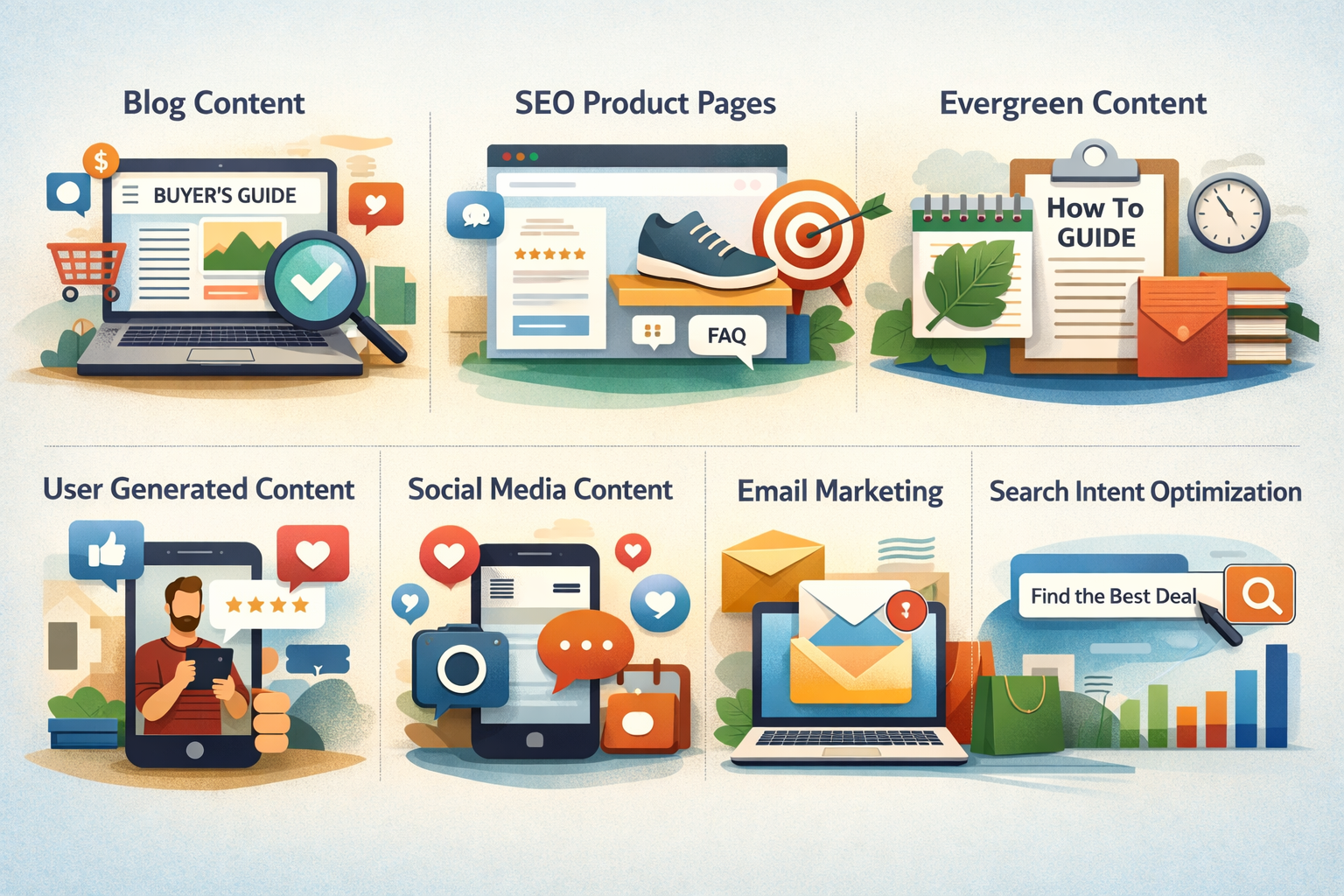
Building High-Intent Blog Content

Not all blog content drives sales. The key is to focus on topics your potential customers are already searching for. For example, instead of writing general content, create blogs around product comparisons, buying guides, or problem-solving topics. This type of content attracts users who are already interested in purchasing, increasing the chances of conversion.

When your blog answers real questions, it builds trust and positions your brand as helpful rather than pushy.

Creating SEO-Optimized Product Pages

Your product pages are not just for listing items; they are powerful SEO assets. Many e-commerce brands ignore this and simply upload product details. Instead, you should write clear descriptions, include relevant keywords, and answer common customer doubts.

Adding FAQs, detailed features, and benefits helps your product pages rank on search engines and also improves user experience. This leads to higher visibility and better conversion rates.

Investing in Evergreen Content

Evergreen content stays relevant for a long time and continues to bring traffic. For example, guides like “How to choose the right shoes” or “Best skincare routine for oily skin” can keep attracting visitors for months or even years.

This type of content gives you consistent returns without requiring constant updates. It’s a smart long-term investment that keeps working in the background.

Leveraging User-Generated Content

User-generated content includes customer reviews, testimonials, and social media posts shared by your buyers. This type of content builds strong trust because people believe other customers more than brands.

Encouraging customers to share their experiences, photos, or videos can improve your credibility and influence buying decisions. It also reduces your effort in content creation while still delivering strong results.

Creating Engaging Social Media Content

Organic social media is not just about posting regularly. It’s about creating content that connects with your audience. Behind-the-scenes posts, product usage videos, and relatable content perform much better than direct selling.

When people engage with your content, your reach increases naturally. Over time, this builds a loyal audience that is more likely to purchase from your brand.

Building an Email Content Strategy

Email marketing is one of the most underrated organic channels. Instead of only sending promotional emails, focus on valuable content like tips, product education, and personalized recommendations.

A well-planned email strategy helps you stay connected with your audience and bring them back to your website. Since these users already know your brand, conversion rates are usually higher.

Optimizing Content for Search Intent

Understanding why someone is searching is more important than just targeting keywords. If a user is looking for information, give them helpful content. If they are ready to buy, show them product-focused pages.

Matching your content with search intent improves both rankings and conversions. It ensures that the right audience lands on the right page at the right time.

Conclusion

Organic content is not a quick win, but it is one of the most powerful ways to grow your e-commerce business sustainably. By focusing on the right type of content, you can attract quality traffic, build trust, and increase conversions without depending heavily on paid ads.

If you invest in these seven areas consistently, your ROI will improve over time, and your brand will become stronger in the long run.

Ecommerce SEO Services in India

In the fast-moving world of online shopping, visibility on Google can make or break an ecommerce business. Over the past year, Google has introduced subtle yet significant changes to its ecommerce Search Engine Results Page (SERP) features. These updates are designed to improve user experience while reshaping how ecommerce brands position themselves in search rankings. If you’re in the business of selling online or providing Ecommerce SEO Services in India, understanding these updates is critical to staying competitive.

The search landscape is no longer just about ranking in the top 10 blue links. It’s about owning rich results, image packs, shopping carousels, product grids, and local listings—all of which are part of the evolving SERP features.

Let’s explore what’s changed in Google’s ecommerce SERP features between 2024 and 2025, and why businesses need to adapt fast.

The Shift Towards Visual Shopping Experiences

Google is prioritizing visuals like never before. While 2024 saw a growing emphasis on image packs and product thumbnails, 2025 has taken it further. Product results are now shown in richer formats with larger images, enhanced price badges, and even live stock availability.

For ecommerce brands, this means that structured data implementation is not optional anymore. Schema markup, high-quality product photos, and accurate stock levels directly influence whether your product shows up in these visual spaces.

Integration of AI-Powered Shopping Guides

In 2025, Google’s SERP features have started incorporating AI-generated shopping guides based on user behavior and preferences. These guides summarize reviews, compare products, and suggest alternatives—all without the user leaving the search page.

Compared to 2024, when users had to manually compare options or rely on ads, the current version allows for deeper user engagement directly in the SERP. This makes it more important than ever for ecommerce businesses to optimize product pages not just for keywords, but for value-added content like FAQs, reviews, and unique selling points.

Enhanced Product Listings and Local Integration

Google has made a serious push towards connecting online and local retail. In 2024, product listings were mostly focused on online merchants. But in 2025, more “nearby” filters and maps are integrated with product availability.

If you’re selling online in India and targeting local customers, this is a great opportunity. Local ecommerce brands can now show product availability in their physical stores via Google’s Merchant Center and Business Profile integration. For agencies providing Ecommerce SEO Services in India, this feature allows clients to dominate both local and national search results.

The Rise of Zero-Click Ecommerce

Another major shift in 2025 is the increase in zero-click searches. With Google showcasing more complete product information right on the search page, users are completing their buyer journey without ever clicking through to a website.

In 2024, ecommerce websites still had a better chance of getting traffic from organic search. But now, unless your brand appears in featured snippets, product cards, or knowledge panels, you might lose out. To stay visible, ecommerce businesses must focus on appearing in these smart features by providing detailed, structured content and submitting accurate feeds to Google Merchant Center.

More Emphasis on User-Generated Content and Trust Signals

Google now gives more weight to authentic reviews, ratings, and user-generated photos. Compared to 2024, when reviews were mostly supplemental, in 2025 they are often featured directly in shopping carousels and knowledge panels.

Encouraging customers to leave honest feedback and upload product images now impacts your SERP visibility directly. Ecommerce sites should also highlight trust signals like free shipping, return policies, and verified brand status—all of which Google now displays in enhanced listings.

Mobile SERP Evolution and the Role of Page Experience

With mobile-first indexing still dominant, Google’s 2025 SERPs are even more tailored to mobile users. Compared to the 2024 design, today’s mobile results show sticky carousels, quick comparison boxes, and AI-powered product summaries.

This means your mobile site must load fast, be easy to navigate, and offer seamless checkout. Poor mobile experience could mean your product doesn’t show up at all, even if it ranks well on desktop. This shift highlights the importance of technical SEO and responsive design for ecommerce platforms.

Final Thoughts

The evolution of Google’s ecommerce SERP features from 2024 to 2025 reflects a broader change in how people shop online. Google is trying to reduce friction in the buyer journey, and that means offering more information upfront.

For ecommerce businesses and SEO professionals alike, the takeaway is clear: the SERP is no longer just a path to your site—it is the shopping experience. To thrive, you must treat every element of the search results page as your storefront.

If you’re looking to grow your online visibility and compete in this changing landscape, working with an expert team offering Ecommerce SEO Services in India could be your smartest investment in 2025.

WordPress Power Your eCommerce Success

In the fast-evolving world of digital commerce, selecting the right platform is the foundation of building a successful online store. Among countless options, WordPress consistently stands out. But is it really the ideal choice for eCommerce websites? Your goals, budget, and desired level of store flexibility will determine the answer. Let’s dive deeper into what makes WordPress a contender and whether it aligns with your eCommerce vision.

Understanding WordPress and Its eCommerce Capabilities

WordPress started as a blogging platform but has since transformed into a powerful content management system (CMS) used by millions of websites globally. What gives WordPress its eCommerce edge is the WooCommerce plugin — a robust, open-source tool that allows businesses to turn any WordPress website into a fully functional online store.

WooCommerce adds all the essentials: product listings, shopping carts, secure checkouts, shipping options, payment gateways, and inventory management. It integrates smoothly with the WordPress ecosystem, making it easier for users already familiar with WordPress to transition into eCommerce.

Flexibility That Fits Every Business Model

One of the main reasons that entrepreneurs opt for WordPress for eCommerce is its unmatched flexibility. Whether you’re selling physical products, digital downloads, subscriptions, or services, WordPress gives you the freedom to customize your store’s layout, features, and functionality without rigid limitations. There’s no one-size-fits-all design here — you build what you need.

With thousands of themes and plugins available, WordPress makes it easy to tailor your site’s appearance and performance. With advanced SEO tools and customer engagement features, you can create an online store that evolves alongside your business.

Cost-Efficiency That Supports Growth

Due to limited budgets, startups and small businesses often seek out cost-effective solutions like WordPress. Unlike platforms that charge monthly subscription fees or transaction percentages, WordPress is free to use. WooCommerce is also free, with many essential features included at no extra cost.

However, some premium themes, plugins, and third-party services might require investment. Even then, the overall cost remains reasonable when compared to other platforms that bundle services into higher recurring fees.

Scalability That Keeps Up With Demand

When your eCommerce business starts to grow, you need a platform that scales with you. WordPress and WooCommerce can handle large catalogs, high traffic, and complex operations with the right hosting and optimization. This means you won’t need to jump to a new platform every time your store expands. You can start small and evolve into a robust online retailer without rebuilding your site from scratch.

SEO-Friendly Foundation

Online visibility is crucial for eCommerce success. WordPress has a strong reputation for SEO, and that translates well for online stores. With proper use of plugins like Yoast SEO or Rank Math, you can optimize your product pages, meta descriptions, and URLs to appear higher in search results. Improved rankings generate organic traffic, which lessens your dependence on paid ads.

Security and Maintenance Considerations

While WordPress is powerful, it requires regular updates and proper security measures. As an open-source platform, it’s more vulnerable to attacks if not maintained properly. Choosing secure hosting, installing SSL certificates, using trusted plugins, and keeping everything updated are essential to protecting your store.

Some businesses prefer hosted platforms like Shopify because of the reduced need for hands-on maintenance. But if you’re willing to put in a little extra effort or hire someone to manage the backend, WordPress offers more control and fewer long-term limitations.

Support and Community Resources

WordPress boasts one of the largest global communities of developers, designers, and users. This means solutions to problems, tutorials, and expert advice are always within reach. Whether you’re a DIY business owner or working with an agency, help is never far away.

WooCommerce also has a dedicated support system and an extensive knowledge base, which makes solving issues and learning new skills much easier than with closed systems.

When WordPress May Not Be Ideal

WordPress has its advantages, but it may not be the most suitable choice for every eCommerce project. If you’re launching a store with very limited technical knowledge and want a plug-and-play setup with minimal configuration, platforms like Shopify or BigCommerce might offer a more streamlined experience.

Similarly, if you prioritize built-in customer support, managed hosting, and don’t want to handle updates or plugin conflicts, then an all-in-one hosted solution could be better.

Final Thoughts: Is WordPress Right for Your eCommerce Journey?

WordPress, combined with WooCommerce, is a strong choice for entrepreneurs who value flexibility, cost-efficiency, and complete control over their online store. It’s ideal for businesses that want to start simple and scale over time, without being locked into a rigid system.

However, it does require some technical know-how or the willingness to invest in expert support. If you’re ready to take charge of your online presence and build a unique store tailored to your brand, then WordPress could be the perfect launchpad for your eCommerce success.