Performance marketing in e-commerce is not about running ads randomly and hoping for sales. It is a system where every rupee or dollar you spend is directly connected to a measurable result like a click, lead, or purchase. The entire focus is on outcomes, not just visibility.
The Core Idea Behind Performance Marketing
In e-commerce, performance marketing works on a simple principle: you pay only when something happens. That “something” could be a user clicking your ad, adding a product to the cart, or completing a purchase. This makes it very different from traditional marketing, where you spend money without knowing the exact return.
Every campaign is built around tracking. Without tracking, performance marketing doesn’t exist. Tools like pixels and conversion APIs help you understand what users are doing after they click your ad. This data becomes the foundation of every decision you make.
How the Funnel Works in Real Campaigns
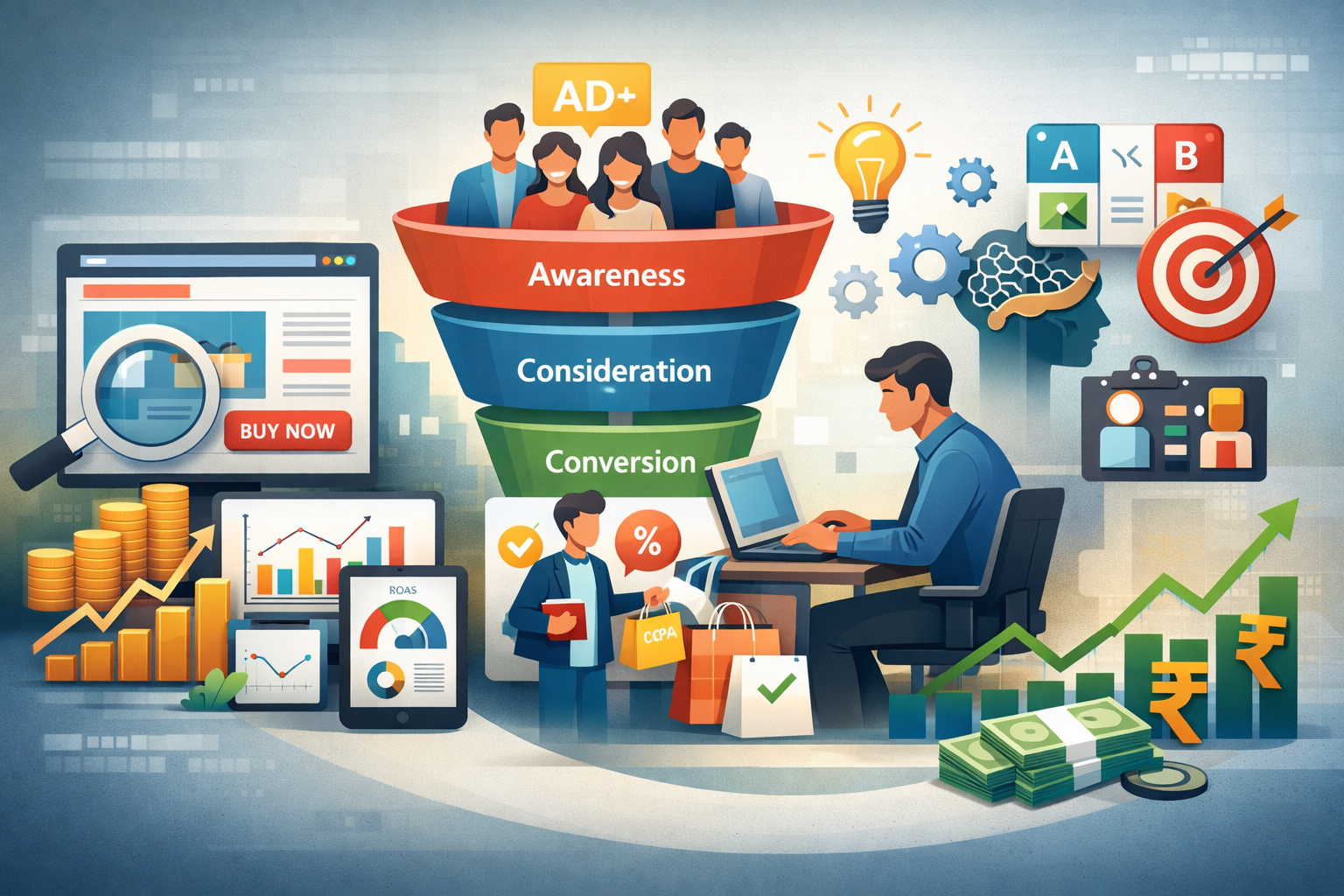
When you run ads for an e-commerce store, you are not targeting everyone the same way. Performance marketing divides users into different stages based on their behavior.
At the top level, you target new users who don’t know your brand. These campaigns are focused on awareness but still optimized for actions like clicks or landing page views. The goal here is to bring the right audience into your ecosystem.
In the middle stage, you target people who have already interacted with your website or social media. These users might have viewed products or added items to their cart but didn’t buy. Here, your ads become more specific. You show them the exact products they viewed or offer them a reason to come back.
At the bottom stage, you focus on conversions. These are high-intent users who are close to buying. Your messaging becomes more direct, often including urgency, offers, or trust signals like reviews and guarantees.
The Role of Creatives in Driving Sales
In e-commerce performance marketing, creatives are not just visuals, they are your main selling tool. A strong creative can reduce your cost per purchase significantly, while a weak one can waste your budget quickly.
Your creatives need to clearly show the product, explain its value, and connect with the audience emotionally. Instead of over-polished ads, simple and relatable content often performs better because it feels more authentic.
Testing is critical here. You don’t rely on one ad. You run multiple variations with different headlines, visuals, and hooks. Over time, you identify which creatives are driving conversions and scale them.
How Targeting and Algorithms Work Together
Earlier, performance marketing relied heavily on manual targeting. Today, platforms use advanced algorithms to find the right audience for your ads.
You still define a broad audience, but the platform learns from user behavior. When someone clicks, engages, or buys, the algorithm analyzes that data and finds similar users who are likely to convert.
This is why consistent data is important. The more conversions your campaign gets, the smarter the system becomes. If your tracking is broken or your campaign doesn’t get enough data, performance drops.
Budget Optimization and Scaling Strategy
Performance marketing is not about spending a huge budget from day one. It starts with testing.
You begin with a controlled budget to test different audiences, creatives, and campaign structures. Once you identify what is working, you gradually increase your budget. This is called scaling.
Scaling is not just increasing spend blindly. It requires maintaining efficiency. If your cost per purchase increases too much, your profitability drops. So the goal is to grow revenue while keeping your cost under control.
Measuring What Really Matters
In e-commerce, the most important metrics are not impressions or clicks. What matters is how much revenue you are generating compared to how much you are spending.
Metrics like Return on Ad Spend (ROAS), Cost Per Acquisition (CPA), and conversion rate define success. If you spend ₹1000 and generate ₹4000 in sales, your campaign is profitable. If not, you need to optimize.
Looking only at surface-level metrics can be misleading. A campaign with high clicks but low sales is not effective. Performance marketing forces you to focus on real business outcomes.
Why Performance Marketing Keeps Evolving
E-commerce performance marketing is constantly changing because platforms, algorithms, and user behavior keep evolving. What worked six months ago may not work today.
Privacy changes, tracking limitations, and competition make it more challenging. That’s why continuous testing, learning, and adaptation are necessary.
Brands that succeed in performance marketing are the ones that treat it as an ongoing process, not a one-time setup.
Final Thought
Performance marketing in e-commerce is a mix of data, creativity, and strategy. It works best when you understand your customer journey, track every action, and keep optimizing based on results.
If done correctly, it becomes one of the most powerful ways to scale an e-commerce business because every decision is backed by real performance, not assumptions.