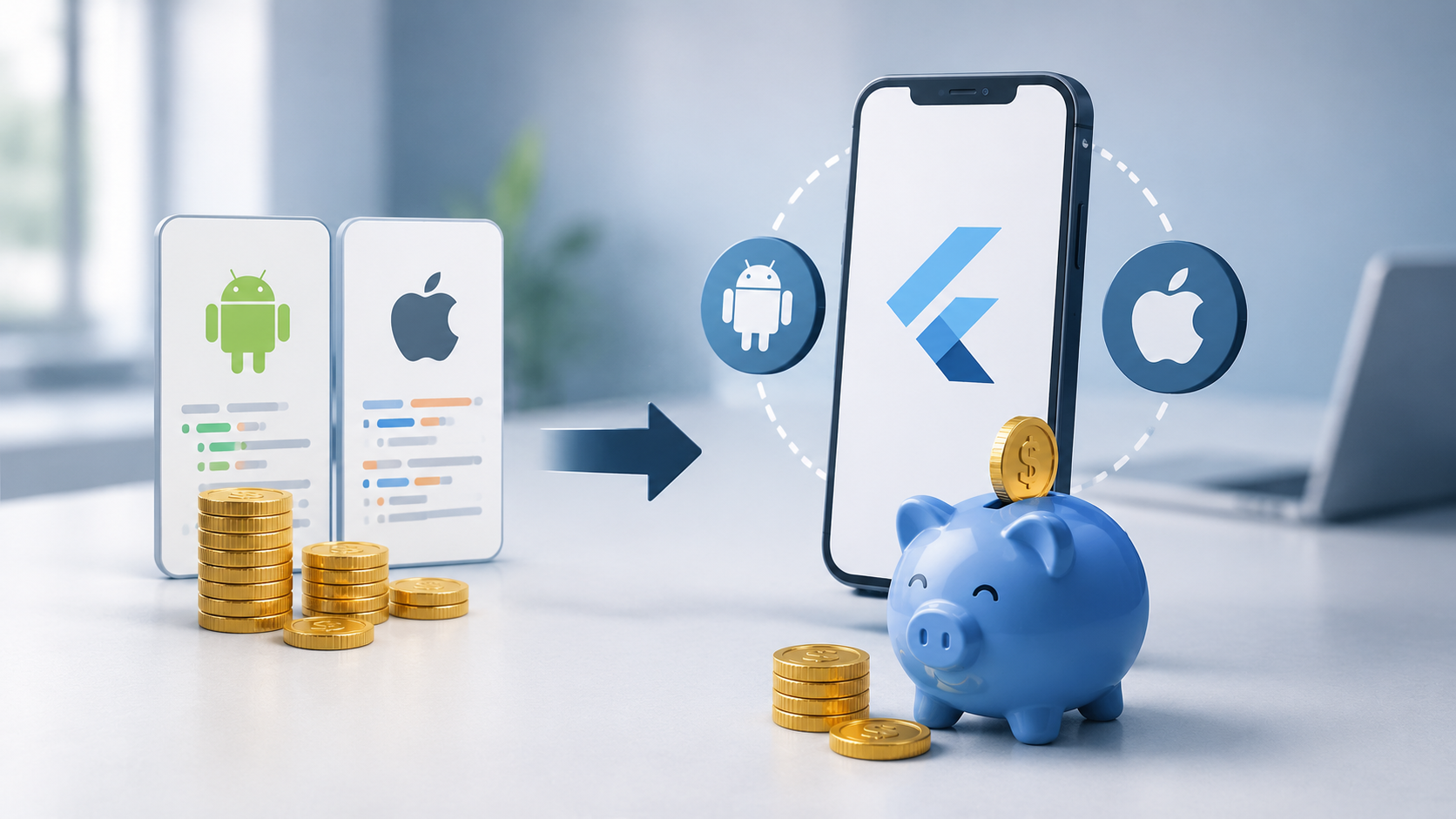
When businesses decide to build a mobile app, one of the first questions they face is whether to create separate apps for Android and iPhone or use a cross-platform framework. While many companies automatically assume they need two separate apps, that choice can significantly increase development costs.
One of our clients learned this lesson firsthand and ended up saving thousands simply by choosing Flutter.
The Challenge
The client wanted to launch a new app for their customers. The goal was straightforward: provide a smooth user experience on both Android and iOS while staying within a reasonable budget.
Initially, the client considered developing two separate applications. One would be built specifically for Android, and the other for iOS. While this approach can work, it requires two codebases, more development hours, and often a larger team.
As the project requirements became clearer, the estimated cost started growing faster than expected.
The client needed a smarter solution.
Discovering Flutter
Instead of building two separate apps, we suggested Flutter.
Flutter is a framework that allows developers to create a single application that works on both Android and iOS. Rather than writing the same functionality twice, developers build it once and deploy it across multiple platforms.
For the client, this immediately changed the economics of the project.
Where the Savings Came From
The biggest advantage was the shared codebase.
Since most of the application was written once, development time was significantly reduced. Fewer hours meant lower development costs from the start.
Testing also became easier. Instead of managing two completely separate applications, the team could focus on improving one core product. This reduced quality assurance efforts and sped up the launch process.
Maintenance costs were another major benefit. Future updates, feature additions, and bug fixes could be handled more efficiently because changes only needed to be made once in most cases.
Over time, these savings continued to add up.
Faster Launch, Faster Results
Saving money was only part of the story.
Because development moved faster, the client was able to launch the app sooner than originally planned. This allowed them to start collecting customer feedback and generating business value earlier.
In today’s competitive market, speed often creates its own advantage. Every month saved in development is another month available for growth, customer acquisition, and improvement.
What the Client Learned
The project showed that choosing technology is not just a technical decision—it’s a business decision.
Many companies focus only on the final app without considering how development choices affect budgets, timelines, and future maintenance. The client realized that selecting the right framework could have a direct impact on profitability.
Flutter provided the balance they were looking for: lower costs, faster development, consistent user experience, and easier long-term maintenance.
Is Flutter Right for Every Business?
Not every project has the same requirements. Some highly specialized applications may still benefit from platform-specific development.
However, for many startups, small businesses, and growing companies, Flutter offers an efficient way to reach both Android and iPhone users without doubling development costs.
It allows businesses to invest more of their budget into marketing, customer acquisition, and product growth rather than spending everything on development.
Conclusion
The client’s decision to choose Flutter wasn’t just about technology—it was about making a smarter investment.
By building one app that worked across multiple platforms, they reduced development expenses, simplified maintenance, and launched faster. Most importantly, they achieved their business goals without stretching their budget.
Sometimes saving thousands doesn’t come from cutting features. It comes from choosing the right approach from the very beginning.