A service business website has one main job: **help visitors understand your service and take the next step**. A beautiful design is useful, but if visitors cannot quickly find what you offer, why they should trust you, or how to contact you, the website may not generate enough leads.
A simple, clear structure can make a big difference.
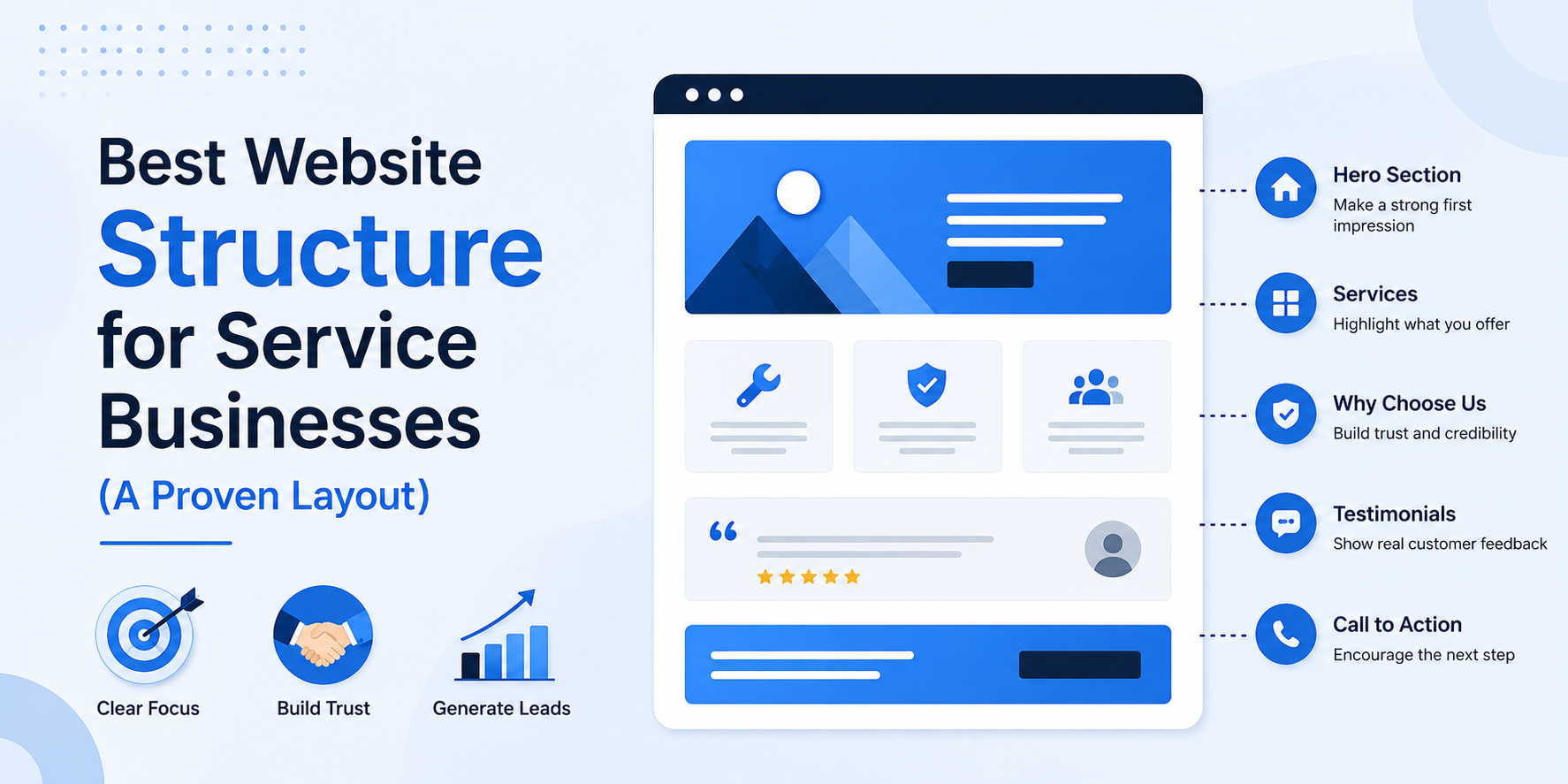
- Start With a Strong Hero Section
The first section should immediately tell visitors what your business does and who you help.
For example, instead of using a general heading like **“Welcome to Our Company,”** use something specific such as **“Professional Plumbing Services for Homes and Businesses.”**
Add a short supporting sentence and one clear call-to-action such as **Get a Free Quote**, **Book a Consultation**, or **Call Now**.
- Explain Your Services Clearly
Display your primary services after the hero section. Each service should have a short description explaining the problem it solves.
If you offer several services, don’t put everything into one large paragraph. To make it easy for guests to locate what they need, use distinct areas or service cards.
For important services, create dedicated service pages. This also gives search engines more focused content to understand.
- Show Why Customers Should Trust You
People usually compare several service providers before making a decision. One crucial question should be addressed on your website:
**“Why should I choose you?”**
Include information such as years of experience, certifications, service areas, guarantees, customer results, or industry expertise.
Avoid making unsupported claims. Real information creates stronger trust than exaggerated marketing language.
- Add Reviews and Proof
Customer reviews can reduce hesitation. Add genuine testimonials with useful details where possible.
You can also include case studies, project photos, client logos, before-and-after examples, or measurable results.
The goal is to show visitors that your business has successfully helped people with similar needs.
- Make the Process Easy to Understand
Your service may seem simpler and less complicated with a straightforward three- or four-step procedure.
For example:
**Contact Us → Get a Quote → Approve the Work → Get the Job Done**
This section is especially useful for businesses where customers may not understand what happens after submitting an inquiry.
- Answer Common Questions
Add an FAQ section near the bottom of the page. Answer questions about pricing, service areas, timelines, availability, guarantees, and other common concerns.
This can help visitors make decisions without having to contact you for every basic question.
- Finish With a Strong Call-to-Action
Don’t make visitors look for a way to get in touch with you. End the page with a clear next step.
Use an action-focused CTA such as **Request a Quote**, **Schedule a Call**, or **Get Started Today**.
A Simple Structure That Works
A strong service business website can follow this order:
Hero → Services → Advantages → Reviews & Trust → Procedure → FAQs → Final CTA
The best website structure is not necessarily the most complicated one. It is the one that **answers visitor questions in the right order and makes taking action easy**.
When your website combines clear messaging, useful information, trust signals, and strong calls-to-action, it becomes more than an online brochure—it becomes a practical lead-generation tool.